Case Study: Helping a Young Trampolinist Overcome Mental Blocks
So That She Can Perform Backward Skills With Trust
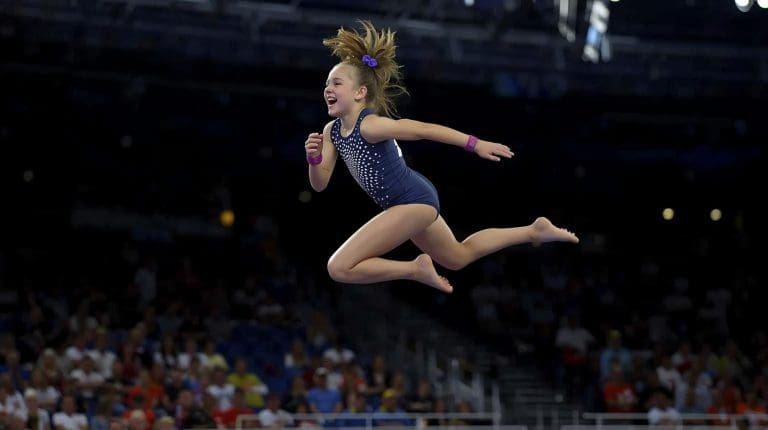
This case study explores the journey of Olivia (pseudonym), a talented 10-year-old trampolinist experiencing fear, hesitation and mental blocks when working on backward moves. An issue common among young trampolinists and gymnasts. Over several weeks, we worked together using a blend of CBT (Cognitive Behavioural Therapy), mindfulness, imagery, and counselling skills to help her regain trust in her body, quieten her mind, and develop strategies to navigate high-pressure training and competition environments.
Children and Young athletes like Olivia often struggle because their mind becomes louder than their skills. Fear, self-doubt, comparison with friends/rivals, and worries about expectations begin to interfere with muscle memory and confidence. This case study shares how, session by session, we helped Olivia take control of her thoughts, understand her emotions, and rebuild confidence in her routines, particularly in backward skills.
- Understanding Olivia’s Motivation and Triggers
Our early sessions focused on getting to know Olivia as a person, not just a trampolinist. She shared what she loves most and takes part in trampolining: fun, fitness, friends, self-control and discipline. We explored why she trains, what excites her, and what she values outside sport such as hanging out with friends, her dog and creative activities. This strengthened our rapport and reminded her that she is more than a trampolinist.
We also explored her previous successes, including strong performances, competing confidently against older athletes. Reconnecting with these positive memories helped her recognise she can perform under pressure when her mind is quiet and her focus is internal.
At this stage we identified her main challenges:
- Fear and hesitation with backward moves
- Jealousy or comparison with confident peers
- High expectations related to outcomes or execution
- Difficulty resetting after mistakes
- Loud self-criticism and worry when her “dog is barking” (her metaphor for intrusive thoughts)
This gave us the foundation for a structured psychological plan.
- CBT Techniques: Rethinking Fear, Expectations and Self-Talk
A major theme in our work was helping Olivia recognise the role of unhelpful thoughts. Together we explored:
- What expectations help her
- Which ones hinder her
- How outcome-focused thinking (“Will I finish my routine?”, “What if I lose height?”) increases fear
- How mindset-based goals (“Be brave,” “Find calm,” “Trust myself”) create freedom and confidence
We created two categories of expectations:
- Unhelpful: outcome, comparisons
- Helpful: bravery, effort, controlling her preparation, staying grounded
We reframed typical “fear thoughts” using CBT tools:
- Catastrophising → Realistic thinking
- Self-criticism → Self-compassion
- What-if fears → What-I-can-control focus
We used journaling regularly, helping Olivia write down her doubts and worries before competitions reducing their power. We also used CBT worksheets to explore self-blame, fear of losing skills, and the physical and emotional symptoms she experiences when blocks appear.
This approach helped her recognise that:
Thoughts are not facts. And fear is something you can work with, not something you must obey.
- Mindfulness & Grounding: Quietening a Busy Mind
Developing a quiet mind was crucial for Olivia. We introduced:
- Box breathing
- Grounding exercises
- Body awareness techniques
- Present-moment attention cues
She learned that grounding is not something you use only in competition it can be practised daily so it becomes automatic when fear shows up.
Her calming routine eventually became:
- Slow breath
- Feeling the trampoline under her feet
- Focusing her gaze
- Using cue words: “Trust,” “Strong body,” “You’ve got this”
We also used mindfulness to help her observe emotions without being overwhelmed by them. She practised identifying when she felt:
- Excited
- Nervous
- Jealous
- Frustrated
- Fearful (“Fearful Fiona”)
- Brave (“Brave Bonnie”)
This emotional literacy was transformative. Recognising that emotions change second by second helped her accept fear rather than fight it.
- Imagery & PETTLEP Visualisation for Backward Skills
Imagery work became a core part of our approach. Olivia often experienced mental blocks because her mind replayed mistakes, fear or worst-case scenarios. Through imagery, we created new mental films that were:
- Calm
- Rhythmic
- Sensory-rich
- Focused on body feel, timing and shape
- Matched to real-world trampoline movements (PETTLEP principles)
She listened to audios before bed every other night to reinforce grounding, imagery and calm emotional state.
Using visualisation, she began to:
- Rebuild trust in backward skills
- Imagine herself landing safely
- Picture strong body positions
- Connect with successful past routines
- Reduce fear’s grip and activate bravery
These sessions helped her restore belief in her ability to “just do it” without overthinking.
- Emotional Processing: Working Through Fear, Shame and Self-Blame
Many young trampolinists and gymnasts feel embarrassed or ashamed when they lose a skill. Olivia shared similar emotions. We worked through:
- Journalling difficult emotions
- Labelling shame, guilt, anger and fear
- Understanding flashbacks related to losing skills
- Exploring why self-blame happens and how it distorts reality
- Recognising that losing skills is not her fault, nor a sign of weakness
These exercises helped her separate:
- Her identity from
- Her temporary struggles
This reduced the emotional weight she carried into training.
- Building Confidence: A Focus on Controllables
We mapped out where Olivia’s confidence comes from:
- Commitment in practice
- Muscle memory
- Breathwork
- Cue words
- Posture
- Bedtime routine
- What she chooses to believe
- Warm-up habits
- Listening to music
- Focusing on her own process (not others)
We highlighted factors outside her control such as judges, competitors, temperature, trampoline type and helped her mentally place them “to the side.” This freed her to concentrate on the controllables that genuinely build confidence.
- Preparing for Competition: A Simple, Repeatable Process
Ahead of a large competition, we finalised her competition plan:
- Grounding, box breathing, journaling
- Listening to audios and music
- Talking with teammates
- Focus on warm-up quality
- Write down doubts and let them go
- Recognise when her “dog is barking” and ignore unhelpful thoughts
She also committed to being:
- Brave
- Calm
- Tall in posture
- Friendly and chatty
- Fully focused on herself
These psychological ingredients helped her feel lighter and more in control in training and under pressure when it mattered most.
Conclusion
Olivia’s journey reflects the challenges faced by many young trampolinists and gymnasts dealing with fear and mental blocks especially around backward skills. Through CBT, mindfulness, imagery, emotional processing and confidence-building work, she has developed tools to quieten her mind, regulate emotions, trust her skills and perform with bravery.
Her progress demonstrates that with the right psychological support, young athletes can learn to work with their mind rather than against it and rediscover fun, confidence and freedom in their sport.
For further details on supporting young trampolinists or gymnasts you may also enjoy the following:
>> Read: Book Review – How the Body Knows Its Mind – Sian Beilock
>> Listen: Is Striving For Perfection A Good Thing In Gymnastics with Alessia Bruno
If you’d like to learn more about how we could help children, trampolinists or gymnasts why not get in touch.
Or if you found this article helpful, please share it with your friends, parents or coaches.
You can also join our online community – THE SPORTS PSYCHOLOGY HUB – for regular Sports Psychology tips, podcasts, motivation and support.

Best Wishes
David Charlton
Global Sports Psychologist who is located near Newcastle Upon Tyne, UK and willing to travel Internationally. David also uses online video conferencing software (Zoom, Facetime, WhatsApp) on a regular basis and has clients who he has supported in the UK, UAE, Saudi Arabia, Australia and New Zealand.
Managing Director – Inspiring Sporting Excellence and Founder of The Sports Psychology Hub. With over 15 years experience supporting athletes, coaches, parents and teams to achieve their goals, quickly.