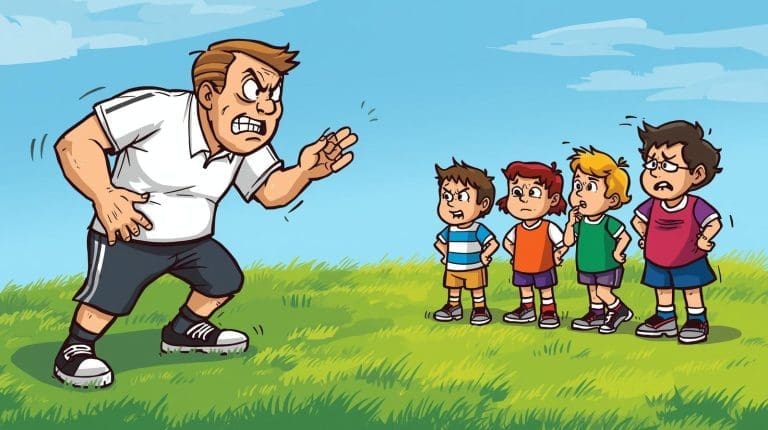
Why fear phrases don’t work with kids
When a coach communicates a threat, even unintentionally, young athletes often go into self-protection mode:
- they play it safe, they aren’t brave
- they avoid mistakes rather than seeing solutions
- decision-making narrows with “don’t mess up” talk in their minds
- confidence dips and errors increase
This is amplified in youth sport because emotional regulation and self-awareness are still developing and a long way off for many. Calm, consistent coaches create psychological safety and that’s the environment where learning really sticks.
A Quick self-check: am I coaching from fear or from clarity?
Ask yourself in the moment:
- What am I feeling right now? (stress, frustration, embarrassment, pressure)
- What am I trying to control? (ref decisions, outcomes, selections, parents, mistakes)
- What’s the next best action I want the kids to do? (press, focus, reset, communicate)
If you can name the feeling and choose the next action, you’re leading the session not reacting.
The three circles that calm a coach instantly
Use this mental model mid-session:
My tone, my words, my body language, my decisions, the next coaching instruction.
Effort, organisation, training tempo, role clarity, behaviour standards, team communication.
Referees, weather, opposition, luck, parent noise, selection politics, results on the day.
Rule: Don’t try to control the uncontrollable. Coach your response.
Fear Phrases → Replacement Process Cues
Keeping standards high without threat language
1) Outcome pressure
- Fear phrase: “You’re better than them, you shouldn’t lose today.”
Process cue: “Focus on your game.” - Fear phrase: “If we don’t score soon, we’re finished.”
Process cue: “Be clever, keep looking for opportunities” - Fear phrase: “This is a must-win match.”
Process cue: “Be brave, concentrate, switch on to the next action throughout.”
2) Threats & punishment
- Fear phrase: “Do that again and you’re off.”
Process cue: “What’s your better option next time?” - Fear phrase: “You’re costing us the game.”
Process cue: “Reset. Next action” - Fear phrase: “Keep playing like that and you can forget about……”
Process cue: “Focus on the next 5 minutes only, what can you do to make it tough for your opponent.”
3) Sarcasm / humiliation that kills learning fast
- Fear phrase: “Brilliant… well done.” (sarcastic)
Process cue: “Unlucky. Keep going.” - Fear phrase: “What we you doing?”
Process cue: What did you notice there? What’s your plan B?” - Fear phrase: “Come on, that’s pathetic!”
Process cue: “Back to basics: keep it simple.”
4) Global labels that attack identity
- Fear phrase: “You’re lazy.”
Process cue: “Let’s lift it by 10% for the next 3 minutes.” - Fear phrase: “You don’t care.”
Process cue: “Show me you care with your next two actions: sprint + communicate.” - Fear phrase: “That was weak.”
Process cue: “Let’s be brave with your next action.”
5) Coach-as-victim language
- Fear phrase: “I don’t deserve this.”
Process cue (to self): “Lead the next moment. Calm voice. Clear cue.” - Fear phrase: “Why does this always happen to me?”
Process cue (to self): “Control what I can: tone, instruction, standards.”
A simple “coach reset script”
Use this when you feel reactive:
- Breathe out, long exhale
- Say to yourself: “Next moment. Next cue.”
- Say to players: “Reset. Simple. Show me your next action.”
This is emotional control in practice: short, calm, behavioural.
High standards without fear: what to praise instead
Praise behaviours that build high performance:
- “Great reset after the mistake.”
- “Brave decision — keep choosing that.”
- “You stayed composed under pressure, well done.”
- “Love that communication — you led others.”
- “You took responsibility: you asked for the ball again, brillant.”
This keeps the culture demanding and safe.
Final Thoughts
A golden nugget taken from the relationship principles of Professor Sophia Jowett work is that children and young athletes perform and learn best when they feel:
- understood
- supported
- aligned with their coach
You could aim for a 3:1 ratio in your communication: 3 process cues for every 1 correction. You’ll still coach high standards, but the young athletes and players will be more open to improvement.
You may wish to listen to:
>> 305 Emotional Control: When Coaches and Athletes Think Differently