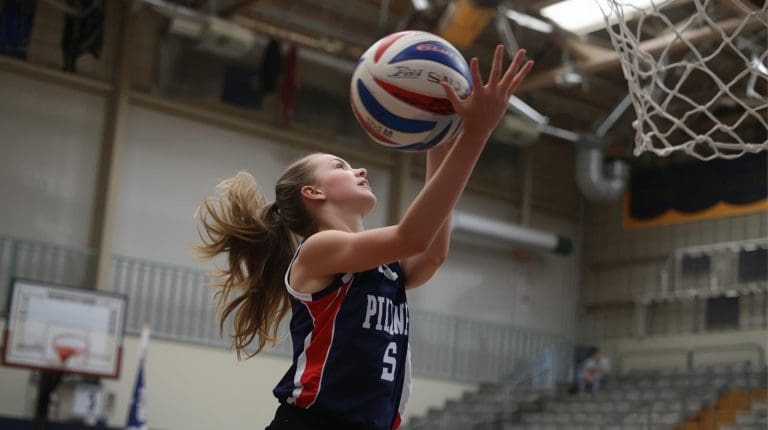
Case Study: Helping a Netball Player When Shooting in Matches
So That She Can Overcome Fear and Build Confidence
This case study explores the journey of Olivia (pseudonym), a talented 10-year-old trampolinist experiencing fear, hesitation and mental blocks when working on backward moves. An issue common among young trampolinists and gymnasts. Over several weeks, we worked together using a blend of CBT (Cognitive Behavioural Therapy), mindfulness, imagery, and counselling skills to help her regain trust in her body, quieten her mind, and develop strategies to navigate high-pressure training and competition environments.
Children and Young athletes like Olivia often struggle because their mind becomes louder than their skills. Fear, self-doubt, comparison with friends/rivals, and worries about expectations begin to interfere with muscle memory and confidence. This case study shares how, session by session, we helped Olivia take control of her thoughts, understand her emotions, and rebuild confidence in her routines, particularly in backward skills.
- Introducing Lola: A Talented Young Shooter Held Back by Fear and Self-Doubt
Lola is an 11-year-old netball player who plays Goal Attack (GA) and Goal Shooter (GS) at a high level. Her coaches praise her movement, timing and shooting technique and in training she performs with confidence and rhythm.
But when match day arrives, Lola’s experience changes dramatically.
Her challenges included:
- Freezing or hesitating when shooting in matches
- Passing off shots she would normally take
- Overthinking when closely marked by defenders
- Worrying excessively about missing
- Becoming smaller in her movement and confidence under pressure
- Playing far more freely in training than in matches
Lola described it perfectly:
“I know I can score… but I get scared when everyone is watching.”
Her parents told me they had “a confident daughter in training and a nervous, self-doubting one in matches.”
This pattern is extremely common in young shooters, especially at GA/GS where the spotlight and pressure can feel intense at any age, even more so for a sensitive 11-year-old still building her identity.
- Understanding the Root Causes: Thoughts, Emotions and Movement
Through initial conversations, reflective exercises and observing Lola’s body language, we identified several important factors.
- Lola’s thinking became fear-driven in matches
Common thoughts included:
- “If I miss, I’ll let everyone down.”
- “The crowd is watching me.”
- “The defenders are too big and strong.”
- “What if I miss again?”
- “My coach will be disappointed.”
These thoughts created anxiety, which then disrupted her timing and movement.
- Anxiety changed her natural shooting rhythm
Drawing on movement-preference principles and cognitive-motor ideas, it was clear that Lola:
- Held the ball longer under pressure
- Became rigid in her shoulders
- Reduced her lift and follow-through
- Stopped breathing fully
- Lost her natural “flow” and timing
Fear physically tightened her up.
- She carried a deep desire not to fail or embarrass herself
Lola is conscientious, kind, and sensitive.
Her fear was not of shooting itself but of being judged.
This made match situations feel emotionally threatening, unlike the safety of training.
- Our Approach: Helping Lola Build Inner Confidence and Free Up Her Movement
Her support plan involved five complementary layers.
- CBT: Calming the Fear-Based Story in Her Head
Together we explored Lola’s unhelpful thoughts and created new, more balanced ones.
From:
- “If I miss, it’s terrible.”
To:
- “Missing is normal, taking the shot is the brave bit.”
From:
- “Everyone is judging me.”
To:
- “My job is to shoot, focus on my rhythm.”
From:
- “What if I miss again?”
To:
- “Focus on this shot only, breathe, lift, release.”
This helped Lola shift from fear to intention.
- Mindfulness and Pre-Shot Routines
We developed a simple reset routine to help her stay present:
- Breath – slow inhale, soft exhale
- Feel – hands on the ball, feet grounded
- Focus – eyes to the back of the hoop
- Flow – commit to the movement
This routine reduced noise in her mind and replaced panic with calm.
- Imagery and Visual Rehearsal
We used vivid, action-based imagery to strengthen her confidence:
- Seeing herself taking a shot with defenders nearby
- Hearing the supportive sounds of the court
- Feeling the ball roll off her fingers smoothly
- Visualising pressure situations before they happened
We built this imagery up using PETTLEP principles to make it lifelike:
- Same emotion
- Same timing
- Same perspective
- Same environment
Repetition built familiarity and her brain started to recognise match tension as “normal.”
- Cognitive-Movement Training: Recreating Pressure in a Safe Way
Inspired by cognitive-motor ideas discussed in a podcast episode with Felix Lehmann and from motor learning research papers, we used:
- Shooting drills with unexpected cues (colour, number, direction)
- Decision-making under mild pressure
- Alternating difficult and easy movements to build confidence
- Tasks that trained adaptability rather than perfection
- Exercises that reconnected her to her natural “feel” rather than technique
This helped Lola become more instinctive, less self-conscious, and better able to adapt when a defender pressured her.
As Felix emphasised in the podcast, when players feel freer in their brain, their movement becomes more fluid.
Lola experienced exactly that.
- Counselling and Emotional Support
A key part of Lola’s development was helping her:
- Understand that fears are normal
- Recognise that mistakes are part of sport
- Accept difficult emotions
- Feel understood and supported
She opened up about:
- Fear of letting her team down
- Pressure she felt as a shooter
- Worries about disappointing adults (coaches and parents) and team-mates
Once she felt truly heard, her confidence began to grow.
- Lola’s Progress: Playing With Freedom, Flow and Confidence
Over several weeks, Lola showed a clear shift:
- Her shoulders relaxed when shooting
- Her timing became smoother
- She released the ball earlier
- She took more shots without hesitation
- She recovered quickly from misses
- She moved with greater purpose and positivity
In a recent match, her coach commented:
“This is a different Lola, she’s shooting bravely and smiling again.”
Her parents shared that she now wants the ball more, rather than shying away when games are tight.
Lola summed it up beautifully:
“I trust myself more now. Missing isn’t scary anymore, I just play.”
- Lessons Other Young Netball Shooters Can Learn From Lola’s Journey
- Confidence is a trainable skill
No athlete or netball player is confident 100% of the time, confidence comes from repetition and support.
- Missing is part of netball
Even elite shooters miss. What matters is responding well.
- Fear and physical tension are linked
Relaxing the mind frees the movement.
- Pressure can be practised safely
Using imagery, routines and cognitive-movement tasks builds resilience.
- Supportive conversations make a huge difference
When a young player feels understood, their courage grows.
Conclusion: Helping Young Netballers Shoot With Freedom and Belief
Lola’s development demonstrates the impact of combining:
- CBT
- Mindfulness
- Movement-based cognitive training
- Imagery
- Emotional support
- Confidence-building conversations
This holistic approach enabled her to transform fear into courage, loosen her grip on perfectionism, and connect again with the joy of playing GA/GS.
For any young netball player struggling with shooting anxiety, match nerves or fear of judgement, the right psychological tools can help them become confident, expressive and resilient on court.
For related resources around cognitive training and overcoming mental barriers that netball players and athletes create for themselves read on.
>> Read: Book Review – Book Review: Motor Preferences in Baseball – David Genest and Matthew Swope
>> Listen: How To Create Better Decision Makers with Cognitive Training – Felix Lehmann
If you’d like to learn more about how we could help children or netball players why not get in touch.
Or if you found this article helpful, please share it with your friends, parents or coaches.
You can also join our online community – THE SPORTS PSYCHOLOGY HUB – for regular Sports Psychology tips, podcasts, motivation and support.

Best Wishes
David Charlton
Global Sports Psychologist who is located near Newcastle Upon Tyne, UK and willing to travel Internationally. David also uses online video conferencing software (Zoom, Facetime, WhatsApp) on a regular basis and has clients who he has supported in the UK, UAE, Saudi Arabia, Australia and New Zealand.
Managing Director – Inspiring Sporting Excellence and Founder of The Sports Psychology Hub. With over 15 years experience supporting athletes, coaches, parents and teams to achieve their goals, quickly.