
Sports Psychology Tips: Is Sports Psychology Measureable?
Many people don't recognise that Sports Psychology can be measured in many ways...
Sports psychology coaching is regarded by some as touchy/feely or pink and fluffy. For instance, I’d be a very rich man the number of times I’ve heard the line, “You’re the guy who does the positive thinking stuff, ha, ha”.
Sadly, assumptions like this put a lot of people off receiving support which mean they drift along doing the same things time and time again, and go on to repeat the same mistakes. I’ve seen this so many times in sport, and it is a huge reason why so many people get disillusioned, give up easily and fail to attack big, and seemingly out of reach goals! Is this familiar?
The sports psychology coaching process is a very effective way of initiating change, developing people professionally and personally, as well as, hugely importantly delivering results. Certainly, in my practice wherever possible I try to ensure clients can measure their progress, so that they can see that their investment was worthwhile at an individual and organisational level. Also, for many individuals, having targets and being able to see tangible progress is a great way to enhance their motivation and confidence too.
Below is a list of some of the tools that I utilise in my practise to ensure we can measure your progress and you go on to achieve your goals.
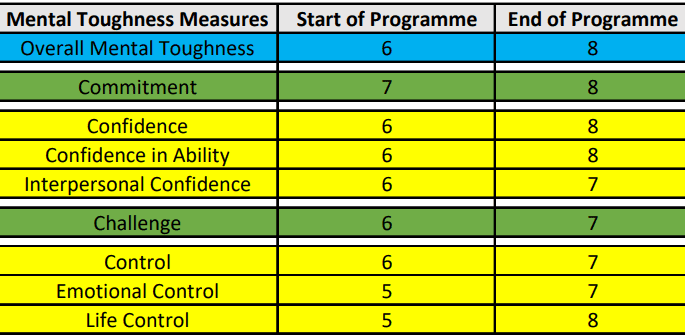
Measure: Psychometric MTQ Plus or MTQ48 Questionnaire measures Overall Mental Toughness and the 4’C’s: Commitment, Challenge, Confidence and Control.
How Used: 1 – / During / End of Coaching Programme for individuals.
How Used: 2 – During / End of Coaching Programme – Team/Organisational wide so return on investment can be measured and wider cultural factors can be addressed.
Below is an image of some Mental Toughness measures from the MTQ48 highlighted in a previous post. In addition for a sample of a MTQ Plus Developmental or Coaching Report please get in touch.
Measure: Tailored Questionnaires are devised that are specific to agreed KPI’s such as trust, team cohesion, team energy etc.
How Used: Club, Team or Organisational wide so return on investment can be measured and wider cultural factors can be addressed.
Measure: Heartmath, Inner Balance feature. Coherence is a measure of the patterns in the heart’s rhythm. It reflects an orderly and harmonious synchronization among various systems in the body such as the heart, respiratory system and blood-pressure rhythms,
How Used: In individual and group programmes to boost focus, concentration and well-being. Utilised in training, homelife and during challenging tasks.
Measure: Heart Rate Monitor
How Used: To measure heart rate in a training and actual environment to see how individuals respond to stress at an individual and/or team level.
In addition to this list a critical part of the coaching process is to help you set outcome, performance and process goals which when done properly with an expert can really help you focus on what is important and provide a real sense of purpose.
If you would like to discuss how sports psychology coaching could help you please feel free get in touch.
Or if you found this article helpful, please share it with your friends, team-mates, parents or coaches. You can also join our community – THE SPORTS PSYCHOLOGY HUB – for regular Sports Psychology tips, podcasts, motivation and support.

Best Wishes
David Charlton
Global Sports Psychologist who is located near Newcastle Upon Tyne, UK and willing to travel Internationally. David also uses online video conferencing software (Zoom, Facetime, WhatsApp) on a regular basis and has clients who he has supported in USA, Canada, South America, UAE, Australian and New Zealand.
Managing Director – Inspiring Sporting Excellence and Founder of The Sports Psychology Hub. With over 10 years experience supporting athletes, coaches, parents and teams to achieve their goals, quickly.

How to Let Go of Mistakes in Padel
Racket Sports Psychology Tips: How to Let Go of Mistakes in Padel A Guide for Young Players, Parents and Coaches Why Letting Go of Mistakes in Padel Is One of the Most Important Mental Skills a Young Player Can Learn Every young padel player makes mistakes. Mishitting a smash, sending a bandeja into the net,
How to Regain Momentum in Tennis
Racket Sports Psychology Tips: How to Regain Momentum in Tennis A Guide for Young Players, Parents and Coaches What Is Momentum in Tennis and Why Does It Matter for Young Players? Momentum in tennis is the invisible force that shifts the feel and flow of a match. One moment a young player is in control;
Conversations With Kids: When Your Child is Trialling at an Elite Sports Academy
Conversations with Kids: When Your Child is Trialling at an Elite Sports Academy For parents and guardians where we give you prompts so that you can have more meaningful conversations with your children to help them build key characteristics such as mental toughness, resilience, confidence, creativity, focus and so on. A Questions for Your Kids
My Son is Trialling at a Cat 1 Academy – How do I Protect His Mental Health?
Football Psychology Tips: My Son is Trialling at a Cat 1 Academy How do I Protect His Mental Health? A discussion we have with a lot of parents whose children are trialling at a Cat 1 Professional Football Club Academies is around protecting their child’s mental health? This is often the scenario where you’ve watched
How to Stop Being Too Hard on Yourself in Tennis
Racket Sports Psychology Tips: How to Stop Being Too Hard on Yourself in Tennis And Why It’s Holding Your Child Back A significant number of young tennis players and their parents get caught up in judgement. Judging a missed shot. Judging a bad game. Judging themselves, their technique, their opponent, or even the conditions. And