



How to Help Young Players Stop Enjoying Their Football

Making mistakes

17 April 2024 Developing The X-FACTOR To Transform Your Football Performances How to Help Young Players Stop Enjoying Their Football It’s great to see a young person on the football pitch enjoying themself.  Taking risks with the ball, giving 110% for their team no matter what the scoreline is, laughing and smiling a lot and …
Read more

How To Improve The Culture At Your Football Club

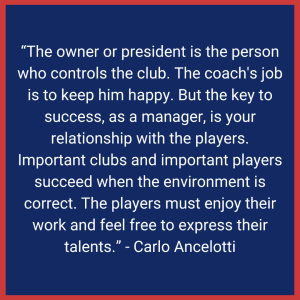
Carlo Ancelotti

27 March 2024 Developing The X-FACTOR To Transform Your Football Performances How To Improve The Culture At Your Football Club In football or soccer clubs around the globe there are some great environments to play football, get better and enjoy the experience and there are some less desirable environments.  Many factors come in to play …

Read more

Do You Worry Too Much About What Others Think Of You?

Strong Love

10 January 2023 Developing The X-FACTOR To Transform Your Football Performances Do You Worry Too Much About What Others Think Of You? Social approval is a very common challenges for many football and soccer players especially young players and can worry their parents and coaches. For the football player who struggles with social approval they’ll …
Read more

Can other people throw you off your game?

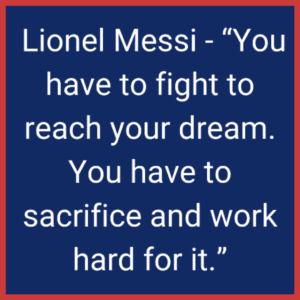
Reach your dream

1 November 2023 Developing The X-FACTOR To Transform Your Football Performances Stop the Mind Reading on the Football Pitch so That you Perform Better Welcome back to our second X-FACTOR email.  Depending on your role in the team your job will naturally be different.  For example, for a defender it could be argued that stopping …

Read more

How To Prevent Burnout In Elite Professional Football To Maximise Performance

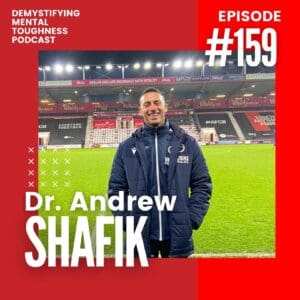
EP 159 Episode Cover Dr. Andrew Shafik

Burnout in football is physical, emotional and mental exhaustion that can follow sustained high stress and pressure. It can affect players, coaches and support staff, with motivation and performance declining, enjoyment fading and sleep suffering. In this episode, club doctor Dr Andrew Shafik shares insights and solutions.

Meet Dr Andrew Shafik

Dr Andrew Shafik

Dr Andrew Shafik is a doctor working in football as Lead Academy Doctor at Millwall FC and a doctor at Chelsea FC. 

He was educated at the University of Aberdeen where he graduated with a Medical degree and Sport & Exercise Science degree.  Andrew also pursued further studies achieving a distinction in an MSc in Sport and Exercise Medicine at the University of Leeds where he was awarded the Sport & Exercise Medicine prize for 2020/2021.  He also holds a Diploma in MSK Medicine and is a Member of the Faculty of Sport and Exercise Medicine.

Andrew has a special interest in football medicine and performance education with roles as Senior Editor and Podcast Lead at the FMPA and Assistant Secretary at the FA Medical Society.

If you’ve got to the point where you’ve experienced physical, emotional and mental exhaustion you may have experienced burnout.  This can happen to people who are subjected to high levels of stress and pressure over a sustained period of time. In elite sport prolonged and intense involvement as an athlete, coach or support member can push you in this direction where your motivation and performance levels can naturally decline.  In addition, your psychological well-being and mental health can also be a cause for concern where you can lack enjoyment in what you do, become more irritable with others and have difficulty sleeping at night.

In today’s episode Dr. Andrew Shafik, a club doctor at Millwall and Chelsea Football clubs goes on share some fascinating insights where we chat about what players, coaches and support staff, can go on to experience. We also share solutions to some of the challenges that people face.

Key Learnings

  • Sports medicine side is connected with understanding injuries and illness.  As a doctor of performance medicine, Andrew seeks to work out how we can utilise our experiences of working within a multi-disciplinary team to maximise the performance and well-being of athletes, coaches or staff.
  • Sports psychologists can be very helpful in assisting medical staff to manage players to an optimal level during their rehabilitation and recovery.
  • Culture and the environment can play a huge part in burnout and the well-being of staff.
  • Your age, stage of career, gender, culture and relationships can impact your mental health.
  • Understanding your levels of mental toughness and other characteristics can be helpful from a self-awareness angle and ensure that you make smarter decisions.

Popular questions about burnout in football

What is burnout in football?

Burnout is physical, emotional and mental exhaustion that can build up under sustained high stress and pressure. In elite football it can affect players, coaches and support staff, and can lead to declining motivation and performance.

What are the signs of burnout in footballers?

Signs include falling motivation and performance, losing enjoyment, becoming more irritable with others and difficulty sleeping. If these persist, speak to your GP or club medical team.

What increases the risk of burnout in football?

Dr Shafik points to culture and environment, and says age, stage of career, gender, culture and relationships can all affect mental health. Prolonged, intense involvement as a player, coach or support staff member can push people towards burnout.

IF YOU ENJOYED TODAY'S SHOW PLEASE SHARE

SUBSCRIBE AND LISTEN ON YOUR FAVOURITE AUDIO PLATFORM

Also, kindly consider taking the 60-seconds it takes to leave an honest review and rating for the podcast on iTunes, they’re extremely helpful when it comes to the ranking of the show and we read every single one of them!

David Charlton

Best Wishes 

David Charlton

Global Sports Psychologist who is located near Newcastle Upon Tyne, UK and willing to travel Internationally.  David also uses online video conferencing software (Zoom, Facetime, WhatsApp) on a regular basis and has clients who he has supported in USA, Canada, South America, UAE, Australian and New Zealand.  

Managing Director – Inspiring Sporting Excellence and Founder of The Sports Psychology Hub.  With over 10 years experience supporting athletes, coaches, parents and teams to achieve their goals, quickly. 

E: [email protected]

Transcript

How to Prevent Burnout in Elite Professional Football to Maximise Performance

Demystifying Mental Toughness Podcast with Dr Andrew Shafik

Introduction – David Charlton

This is the Demystifying Mental Toughness Podcast, hosted by me, David Charlton.

Whether you’re listening to build your own mental toughness or to better support other people, athletes or clients, my aim is to help you understand this fascinating and developable personality trait and how it can influence performance and wellbeing.

Hi, I hope you’re well and you’ve had a good week.

I’m continuing the theme from last week’s episode, where we explored mental health literacy in sport.

This time, my guest is Dr Andrew Shafik, and we’re discussing burnout, wellbeing, mental health and mental toughness in elite professional football.

Andrew is a club doctor who has been involved with Millwall and Chelsea Football Clubs, and he shares some fascinating insights into the demands experienced by players, coaches and support staff within elite football environments.

Enjoy.

There is Hope: How to Overcome Focal Dystonia

EP 156 Episode Cover Ruth Chiles

There is Hope: How to Overcome Focal Dystonia

Ruth Chiles

Ruth Chiles works with professional musicians from many of the world´s leading symphonic orchestras, as well as from other genres such as jazz, rock and blues. Her experience is also with premier and international league sports clubs, and professional dancers, gymnasts, basketball players, skiers and track athletes, enabling them to resolve their performance blocks, especially focal dystonia. She has nearly 30 years of formation in and experience with leading edge neuroplasticity and neurogenesis techniques. As a musician herself who suffered and has healed herself from focal dystonia and other performance blocks, she understands first-hand what it is like to have your deepest passion snatched from you, the experience of the recovery process, and the joy of returning to confident, freedom and fluidity in your playing.

In mainstream sports psychology when helping individuals to develop their mental toughness and overcome performance challenges sport psychologists are likely to use interventions such as cognitive restructuring, visualisation, goal setting, mindfulness and other relaxation techniques to help athletes.  However, when athletes experience trauma and difficulties such as the yips or mental blocks other tools may be required to help them overcome the challenges that they face. 

Today I chat with Ruth Chiles, author of The Focal Dystonia Cure, who is a brainspotting practitioner, she goes on to tell you more about focal dystonia and neurological causes of this condition.  She also shares some practical tips for those of you who struggle with focal dystonia.  This episode is a great listen for those people who suffer from the yips or mental blocks or have experienced trauma in some form.

Key Learnings

  • Focal dystonia is a very extreme somatisation in the body of a mental block where the particular movement or a particular part of the body is out of control.
  • What is going on in the nervous system sits underneath the body movements, or body blocks.
  • Fight and flight responses are when you are highly activated in the nervous system whereas a freeze response is when you experience hyper activation.
  • For some people their nervous system has been in a constant state of survival since before child birth.  Our very early life history and our attachment to our mother plays a part.
  • Brainspotting was developed by a New York psychologist called David Grand where we rewire parts of the brain so that people can respond differently in specific situations.
  • We connect to the sub cortex through the body not through the thinking mind.
  • When performing we are often in survival mode which can impede fluidity, enlarge muscles and inhibit your fine motor skills.

Connect with David Charlton

Sign Up to The Mental Edge

Join David @ The Sports Psychology Hub

Instagram, Facebook, Twitter and LinkedIn

Connect with Ruth Chiles

Website

Book: The Focal Dystonia Cure: Powerful and Definitive Practices to Completely Heal Yourself

Ruth Chiles on Facebook

Ruth Chiles on YouTube

Relevant Podcast Episodes

Ep013: Karl Morris – How to stay present like a major champion

Ep012: Alessia Bruno – The Yips, Crashes, Trauma in Sport there is hope for Athletes

Ep092: Dr James Hegarty – ACT in Sport, Improving Performance through Mindfulness

Ep131 David Charlton – How to Deal with Self-Criticism using Self Compassion – FINAL PART

Ep142: Alessia Bruno – Is Striving for Perfection a Good Thing in Gymnastics?

Relevant Blogs

Blog: Helping a Critical Child When You’re a Parent

Blog: How to Support an Angry Young Athlete

Using ACT and Mindfulness to Improve Your Sporting Performances

Why You Should Meditate To Improve Your Sport Performance?

Guided Mindfulness Meditation Practices with Jon Kabat-Zinn

IF YOU ENJOYED TODAY'S SHOW PLEASE SHARE

SUBSCRIBE AND LISTEN ON YOUR FAVOURITE AUDIO PLATFORM

Also, kindly consider taking the 60-seconds it takes to leave an honest review and rating for the podcast on iTunes, they’re extremely helpful when it comes to the ranking of the show and we read every single one of them!

David Charlton

Best Wishes 

David Charlton

Global Sports Psychologist who is located near Newcastle Upon Tyne, UK and willing to travel Internationally.  David also uses online video conferencing software (Zoom, Facetime, WhatsApp) on a regular basis and has clients who he has supported in USA, Canada, South America, UAE, Australian and New Zealand.  

Managing Director – Inspiring Sporting Excellence and Founder of The Sports Psychology Hub.  With over 10 years experience supporting athletes, coaches, parents and teams to achieve their goals, quickly. 

E: [email protected]

How to Help a Child Who Wants to Quit Sport

EP 141 Episode Cover David Charlton

How to Help a Child Who Wants to Quit Sport

David Charlton

By working with David Charlton, you and your organisation will be better equipped to rise to modern day challenges and better informed to thrive on and off the pitch, course or court.  Where he inspires individuals and teams to:

  • Cope with pressure and challenges more effectively
  • Maintain positive mental health
  • Compete with confidence more often
  • Manage your emotions better
  • Improve your commitments levels

David is a Mental Toughness Practitioner, as well as a Health Care and Professions Council (HCPC) Registered Sport and Exercise Psychologist.  He has successfully supported athletes, teams and organisations for over 10 years in order to ensure that they perform at their maximum more often.

He has a comprehensive knowledge around the development of Mental Toughness, a plastic personality trait, which determines or limits people to deal effectively with change, challenges and stressors. In today’s climate, during the Coronavirus pandemic this quality is becoming more and more valuable to individuals, teams and organisations. 

In this short solo episode, I answer a question posed by a parent.  “My son has had a tough time recently and often talks about not wanting to continue with football.”

Sadly, this question appears to be a common one at present and shows no signs of going away potentially down to the pressures placed on children at a young age, both in their sport and education.  I do my best to give sporting parents one idea on how you can help them and open up a conversation on the topic.

Key Learning

  • Ask your child why they play football or sport.
  • Find out what they love about sport.
  • Check-in with yourself, why would you like your children to play sport?
  • Now check if you share common ground, if there is a big difference in your motivations I’m hoping you’ll question your approach and consider how you communicate with them. 

Connect with David Charlton

Sign Up to Conversations with Kids

Download THE FOCUSED ATHLETE CHECKLIST

Join David @ The Sports Psychology Hub

Instagram, Facebook, Twitter and LinkedIn

Relevant Podcast Episodes

Ep067: David Charlton – Supporting Children to Transfer their Skills from Training to Competition

Ep074: David Charlton – How Can I Make My Child Feel Confident?

Ep082: David Charlton – Supporting Children in Sport with Positive Feedback

Ep085: David Charlton –  David on Being Tough Vs Being Comfortable in Your Own Skin Part 4

Ep122: Prof Camilla Knight – Helping Your Children Get The Most From Their Sporting Experiences

Other Relevant Blogs and Resources

Blog: A Confidence Checklist for Parents

Blog: Pre Match Tips for Parents

Blog: How Do You Give a Young Golfer Self-Confidence?

Blog: 5 Reasons Why Being Released from a Football Academy is Difficult

Children and Youth Motivation for Sport Quiz

Child and Youth Motivation Quiz for Parents

IF YOU ENJOYED TODAY'S SHOW PLEASE SHARE

SUBSCRIBE AND LISTEN ON YOUR FAVOURITE AUDIO PLATFORM

Also, kindly consider taking the 60-seconds it takes to leave an honest review and rating for the podcast on iTunes, they’re extremely helpful when it comes to the ranking of the show and we read every single one of them!

If you would like to share your experiences as a soccer parent or get insights regarding kids soccer sports psychology, you may also wish to join David in The Sport Psychology Hub.

David Charlton

Best Wishes 

David Charlton

Global Sports Psychologist who is located near Newcastle Upon Tyne, UK and willing to travel Internationally.  David also uses online video conferencing software (Zoom, Facetime, WhatsApp) on a regular basis and has clients who he has supported in USA, Canada, South America, UAE, Australian and New Zealand.  

Managing Director – Inspiring Sporting Excellence and Founder of The Sports Psychology Hub.  With over 10 years experience supporting athletes, coaches, parents and teams to achieve their goals, quickly. 

E: [email protected]

3 Tips to Deal with Bullying in Sport

Hockey Sports

Sports Psychology Tips: 3 Tips to Deal with Bullying in Sport Pressures in sport can mean bullying, wrongly, becomes part of the game Competitive sport, such as hockey or netball, are known for encouraging a positive environment, particularly within youth sport, as well as teaching athletes the importance of friendship amongst teammates. However, these competitive